
Market Update – Week ending 6 November 2026 -TRUMP ROUTED IN US MIDTERM ELECTIONS

 November 2026
TRUMP ROUTED IN US MIDTERM ELECTIONS
Nanny Burnham’s Chancellor delivers anaemic UK Budget
Bank of England raises Base Rate by 0.25% to 4.0%
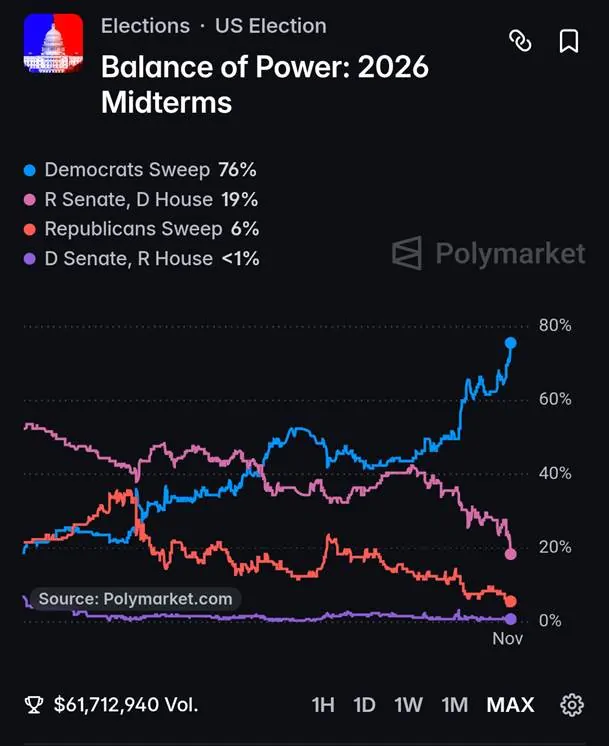
US Midterm Elections: a Vote Against Trump. Trump asked voters to vote as if he was on the ballot…. and they did!
President Donald Trump urged US citizens to vote at the Midterms as though he himself was on the ballot, and they did.
It was a resounding message from the downtrodden, forgotten ordinary citizens and their families in the US who are struggling to meet their housing costs, their food bill, their energy costs and their fuel costs at the pump, that they have had enough of Trump’s corruption which has seen his own and his families wealth soar, and his oligarch multi-billionaire friends (who arguably bought the election for him and sat behind him in the first row at his second inauguration in January 2025) get richer and richer while the vast majority of US citizens, if they can get by at all, live pay cheque to pay cheque. Senator Bernie Sanders has done the maths, and he points out that the top wealthiest 1% in the US own more wealth than the bottom 90% of US citizens added together.
Senator Bernie Sanders goes on to say that Elon Musk, one (allegedly) private citizen of the US, personally owns more wealth than the bottom 53% of Americans combined wealth, in no small part due to US Government awarding him countless colossal government contracts which the Democrats have said they want to investigate as they are by no means transparent. Musk allegedly receives more money from the US taxpayer than NASA and Medicaid combined, and this is also something that the Democrats will be looking into, as well as getting to the bottom of why a private US citizen can simply choose to turn off the Ukrainian’s Starlink access to help Trump’s friend, President Vladimir Putin, continue to bombard Kiev and the Ukrainian energy infrastructure and civilian targets. You could not make it up.
Thankfully, democracy has won through, and as we commented in our last Newsletter in August, “There is always hope, if honest people with honest values work together things will come good, (and that) in the end, Karma wins out, people and businesses, and nations get what they deserve”. The American voters have spoken, they did precisely what Trump asked of them which was to vote as though he himself was on the ballot, and now the US has to work hard to try to undo the dreadful mess that Trump and his closest allies in the administration have caused in such a short time of Trump 2.0 since January last year. The US under Trump and this Administration has been in sharp decline with their reputation on the global stage damaged beyond all recognition, with once long-standing allies planning a future around the US as opposed with the US.
US equities opened higher on 4 November and then fell sharply yesterday, 5 November, as investors weighed a Democratic sweep of both the Senate and the House against the prospect of gridlock for the rest of Trump’s term. The result can be interpreted mostly as a rebuke of President Trump, rather than a vote in favour of the Democrats’ progressive policies.
Key points
- Democrats won both houses of Congress, including Senate seats in Republican strongholds such as South Carolina, Kansas and Texas.
- Treasuries and gold rallied and tech stocks sold off overnight, before European markets initially steadied and US markets opened higher on 4th November.
- 5th November saw global markets fall
- Elon Musk invested US$500 million in trying to buy the Midterm elections Trump to maintain his corrupt influence on US elections and on policy making for his self-enrichment
- Musk’s SpaceX Shares fell a further -9.05% yesterday, making it -28.09% return for his investors in just one month, -37.33% loss over 6 months and a staggering -40% loss since June this year
- Private Office Asset Management read the result as a rejection of President Trump’s policies, his corruption, his illegal war with Israel on Iran, and his total indifference to US citizens real issues of rising costs rather than a specific endorsement of the Democrats.
- Centrist Democrats gain ground, and gridlock looks likely for the rest of Trump’s term, as Trump will undoubtedly become the “veto” President. He may not be able to get any of his own way, but the President’s office (which any sane person can see he is not worthy of holding) has the power to veto laws passed by Congress which comprises: (i) The House of Representatives (Lower Chamber) and (ii) The Senate (Upper Chamber). Trump could become “The Veto President”
- Scale of Trump and his cronies disastrous Midterm losses could see senior resignations, and even potential impeachment proceedings against Trump and his ridiculously under-qualified Secretary of Defence (read War) Pete Hegseth.
What happened?
As was widely predicted, the US midterm vote of 3 November saw the Democrats take control of both houses of Congress. The results delivered a check on President Trump’s power, with voters citing frustration over the rising cost of living (particularly higher fuel and energy prices), the prolonged war in Iran, the AI data-centre build-out, and suspected corruption in the Oval Office which has overseen Trump’s family use the Presidency for self-enrichment.
The biggest shocks came not in the swing states but in Republican strongholds: Democrats won Senate seats in South Carolina, Kansas and Texas for the first time in decades.
How did markets react, and how has Trump reacted?
As the results picture became clear, Treasuries rallied – the 10-year yield fell about 6bp to just over 4.9% overnight [2] – and tech stocks sold off, before European markets steadied. Investors sought safe-haven assets with the Democratic result seen as putting the brakes on Trump’s fiscal agenda – gold also jumped in the initial reaction.
The dollar weakened against all G10 peers, given its link to the AI trade and expectations that deregulation will slow. This could be the most durable market move from the result.
However, markets initially stabilised relatively quickly – nimble investment strategists who buy the market dips emerged in equities, and Private Office Asset Management are in this category, having been out of the market recently with up to one third of our clients’ portfolios to protect against potential falls, we have bought into the dip yesterday and today.
President Trump has somewhat surprisingly signalled a willingness to work with Democrats, most likely simply because he will have no choice as even his closest allies in his administration, and who must take equal share of the blame for enabling Trump’s farcically destructive time in office this time around, are quickly trying to distance themselves from him. Trump knows that the Democrats, who now hold the Senate and the House of Representatives by significant majority, will be looking to investigate him and bring him to account.
With regards to markets, concurrent strong results from chipmaker Advanced Micro Devices (AMD) and server maker Super Micro Computer helped offset the initial anti-AI sentiment. Wall Street indices later opened higher in early trading yesterday 5th November, but later on markets fell back quite significantly amid concerns that a Democratic governor in Texas could disrupt the AI build-out, with the state home to 27% of planned US data-centre projects by gigawatt capacity, and of course Texas is now the home of Musk himself.
Chief Investment Officer’s view
Yesterday’s long anticipated US midterm election results show the blue wave of the Democratic vote that is even more of a landslide than was anticipated, as the margins of victory in the most contested states were meaningful, leaving little room for Trump to dispute. Trump is now the quintessential, proverbial lame duck President, but we now wait to see if this heavy defeat (for which he accepts none of the blame, telling Fox News that if he had been on the ballot paper, he would have won a landslide victory, and the problem, he said, was that his own name wasn’t on any of the ballots) tempers him or provokes him to even more bizarre rhetoric. Narcissist as he is, Trump himself will know that as far as the voters are concerned, it was, as he told them to believe, he himself who was on the ballot paper. Trump being Trump he probably remains the only person on earth genuinely surprised by the scale of his rejection by the American voter.
The Democrats have picked up Senate seats in deep-red states including Ohio, Iowa, Kansas, Texas and South Carolina who will send centrists to the Senate. This means that Democratic centrists will hold sway over the Democratic Socialists of America (DSA), the influential grassroots socialist and activist group on the party’s left.
Importantly, we see this result as mostly a rejection of Trump’s policies rather than a vote in favour of the Democrats’ policies. States with deep agricultural economies turned blue as voters rejected high energy prices and the impact of Immigration and Customs Enforcement (ICE) operations on farm workers. This is also a vote against corruption, a primary concern for voters.
Democrats will have a comfortable majority in the House of Representatives, with Hakeem Jeffries, expected to become Speaker, able to navigate the extremes well. In the Senate, the Democrats will chair the Banking and Judiciary committees. The biggest implication is yet to come as many red states have elected Democratic governors (Georgia, Ohio, Texas, Wisconsin) and the Senate will now tilt blue going into the next presidential election.”
Phil Simmonds LL.B(Hons), MBA, Chief Investment Officer | Head of Wealth Management
Sector view
“For AI infrastructure, the result is an incremental negative. We expect more state-level rules requiring data centres to supply their own power or support the grid. That raises building costs but does not make data centres uneconomic, but after the recent sell-off, although markets initially looked to be fully discounting the political risk, they have since pulled back significantly as they weigh up the potential obstacles, and regulation that AI may soon be subject to with the Democrats soon to be running Congress.
In defence, funding is the pressure point after Congress rejected the most recent military supplemental, though replenishing munitions stockpiles should be hard to oppose. In healthcare, hospitals and insurers stand to gain if Democrats restore, as they say they will. some of the funding that was cut. Pharmaceuticals could face renewed pressure on drug pricing as US citizens pay the highest prices on earth for drugs, while biotechnology may be better insulated.
Whilst some of this was priced in ahead of the Wednesday vote. Semiconductors and US aerospace and defence have both lagged global equities over the past three months. Ordinarily it might be a reasonable expectation that the certainty of knowing the result could lead to some recovery in market sentiment, but it might take a bit of time for all of the permutations of this landslide change to work its way through and the outcome and consensus of that is by no means certain.”
Sebastian Simmonds BSc.(Hons), ACSI, Managing Director | Portfolio Manager – Bespoke Multi Asset
UK BUDGET 2026: Higher Inflation, higher welfare Spending and Higher Taxation
The new Chancellor delivered a relatively uneventful, rather anaemic Budget that defers the major decisions to 2027. While the policy measures themselves were modest, the underlying fiscal position deteriorated due to higher energy prices. This is the third consecutive year in which borrowing, spending and taxes have all increased meaningfully. Borrowing exceeds the March forecast in every year because spending, led by debt interest which has ballooned with rising interest rates that the government has to re-issue matured debt at, and indeed new debt via the DMO (Debt Management Office), has been revised up by more than tax receipts. The Government remains within its borrowing rules, but with a narrower safety margin than in March. The UK taxpayer now pays almost £1 out of every £9 that the government spends, on debt interest alone, with the national debt now standing at more than £3Trillion and rising month on month.
OBR (Office for Budget Responsibility) forecast: Inflation up, headroom down
In its Economic and fiscal outlook, published alongside Chancellor John Healey’s Autumn Budget 2026, the Office for Budget Responsibility (OBR) described the UK’s economic and fiscal position as “very challenging”. Repeated adverse shocks have contributed to weak GDP growth and elevated government borrowing. Growth for this year has been nudged up slightly to 1.2%, but the 2027 forecast has been cut by half a percentage point to 1% as higher energy prices and interest rates weigh on activity. In all probability these forecasts are optimistic, anaemic as the forecast for growth is.
Consumer Prices Index (CPI) inflation is expected to average 3.1% this year, around three-quarters of a point above the March forecast. It is then forecast to peak at around 3.8% in early 2027 and average 3.4% next year. That is well above the Bank of England’s July forecast of 2.8% for 2027, and the OBR’s forecast assumes the Bank of England base rate rises to just over 4.25% by mid-2027.
With gilt yields reaching multi-year highs this year, this Chancellor was always likely to prioritise fiscal discipline. The OBR forecasts fiscal headroom, the margin by which the government is expected to meet its fiscal rules, of £15bn in 2029-30. That is £7bn less than at the 2025 Budget. It is a slim cushion: the OBR puts the chance of meeting the rule at just 56%, and the margin is well below the average of close to £30bn held by Chancellors since 2010. Borrowing is forecast at 4.2% of GDP (£133bn) in 2026-27, falling to 1.8% (£67bn) by 2030-31. It is higher than the March forecast in every year: by around £18bn in 2026-27, £16bn in 2027-28 and an average of £11bn a year thereafter. The OBR also confirmed that debt interest costs are set to rise from £109bn in 2025-26 to £160bn by 2031-32.
Cash ISAs have been spared, but income is taxed even harder
The Chancellor confirmed that plans to limit cash ISA subscriptions to £12,000 of the £20,000 annual allowance for under-65s, as announced a year ago by his under-qualified predecessor Rachel Reeves, will not go ahead. He will also consult the investment sector on a new “starter ISA” to reward first-time investors, though details were very scant indeed.
In line with pre-Budget reports, there was no change to headline Capital Gains Tax (CGT) rates or to stamp duty. However, Healey announced that tax rates on savings and property income will rise by a further 2 percentage points from April 2027, on top of the increase of the same amount announced at the 2025 Budget. This takes the basic, higher and additional rates to 24%, 44% and 49% respectively. The OBR expects some savers to shift more of their money into ISAs in response and warns that the higher property income rates are likely to push up rents over time. It appears that Labour just do not understand, or care, about the consequences of their incessant higher taxation fixation.
Being naturally anti-business, Nanny Burnham and Healey also targeted changes to the taxation of business owners. The lifetime limit for Business Asset Disposal Relief will be halved from £1m to £500,000 from April 2027, while a new 10% CGT rate will apply to qualifying founders of high-growth or innovative companies from the same date. From April 2028, reforms to the taxation of company distributions aim to stop owners extracting profits at CGT rates rather than dividend rates.
Banks will face a temporary increase in the bank surcharge – an extra corporation tax on banks’ profits, charged on top of the standard rate – from 3% to 6%, running from 1 January 2027 to 31 March 2028. Meanwhile, income tax thresholds remain frozen until April 2031, which the OBR identifies as a key driver of the UK’s tax burden reaching a record high. We can expect yet more wealthy entrepreneurs ultra high taxpayers to depart these high-tax, welfare state, UK shores – no doubt passing the incessant flotilla of small boats on their way to us.
Some Issues to watch
A narrow margin against significant pressures. The OBR forecast assumes a fuel duty rise postponed five times before, real-terms cuts to unprotected services from 2028 that the OBR expects to be reversed, and a final-year spending total not yet agreed with departments.
Energy and interest rates. Oil and gas prices are assumed to fall, which is sensible but optimistic and uncertain. Higher energy prices raise inflation, the cost of inflation-linked debt and indexed and increasing welfare benefits. Separately, a one percentage point rise in borrowing costs would cost roughly the whole safety margin, so the bond market and the fiscal plans now constrain one another.
A third consecutive year of higher borrowing, spending and taxes. The policy changes are modest, seriously anaemic, but the rise in borrowing is substantial and stems from energy-driven inflation that lifts debt interest and Nanny Burnham’s Labour’s ballooning welfare costs which they are steadfastly committed to. The Chancellor can only redistribute the burden, and this Budget shifts it towards savers, landlords, banks and companies to fund household relief.
Relief rather than reform. The Budget does not right-size spending to fund defence, improve the regulatory environment for private investment, or move the tax mix towards less distortive bases. Each crisis has added to the national debt and reduced the capacity to respond to the next; this weak budget does absolutely nothing to change that.
Deferred decisions. Tax increases fall on savings, property income, bank profits and investment allowances. Departmental budgets, the path to 3.5% of national income on defence, social care reform and devolved tax arrangements all await the 2027 spending review.
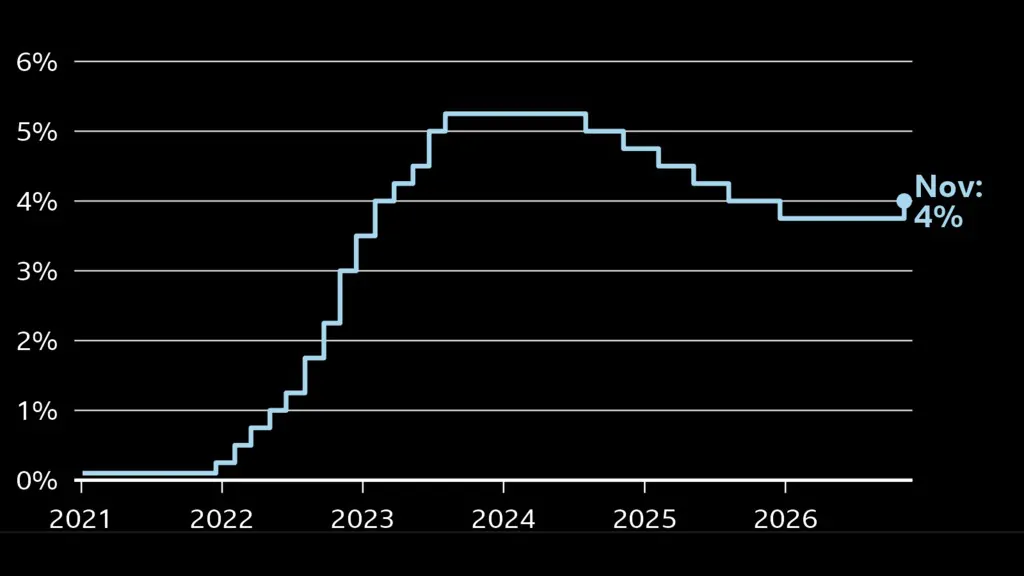
Bank of England raises the base rate by 0.25% to 4.0%
Interest rates have risen for the first time in more than three years, and the Bank of England has signalled a further increase is likely unless the US-Iran war is resolved. Rates rose to 4% from 3.75% in a bid to curb inflation mainly driven by the conflict’s impact on global oil prices.
Andrew Bailey, the Bank’s governor, said the decision “shouldn’t be seen as the first in an inevitable long sequence of hikes”, but warned “unless the conflict in the Middle East is resolved, neither does it seem likely to be the last increase”.
The higher level will increase the cost of borrowing for businesses, and for individuals and families via things such as mortgages, loans and credit cards, and of course government borrowing on new Gilt (debt issues).
The Bank’s rate-setting committee all backed increasing interest rates, with eight out of nine voting in favour of the rise to 4%. One member wanted an even bigger increase to 4.25%.
Bailey said the hike was warranted due to higher energy prices and pointed to what happens in the Middle East as the main factor in future decisions.
“Put simply, it requires real progress towards settling the conflict in the Middle East,” the governor said. Bailey said he could “see the argument” for a further rate hike, before taking a “more conditional approach” dependent on the path of energy prices and inflation in the coming months.
However, the views of members on the rate-setting committee differed on the path forward. Clare Lombardelli agreed there was “likely to be a case for a further increase in rates in the near term”, while Megan Greene went further, suggesting “additional hikes” might be likely depending on how inflation impacted wages, prices and the jobs market. However, Alan Taylor said the rate rise was a “risk-management ‘one-for-now’ insurance hike”.
Inflation, which measures the pace of price rises over time, is well below its peak of a few years ago but remains above the Bank of England’s 2% target and is expected to increase further next year. Prices rose 3.5% in the year to September 2026, largely due to higher fuel prices. Millions of households are also set to be hit by energy bill increases in January. Higher fuel prices can lead to prices rising for a host of goods and staples as businesses pass on higher costs to customers.
But the Bank said there was “limited evidence” this had happened so far for goods, such as food, with some firms absorbing cost increases and accepting lower margins.
In an interview with the BBC, Andrew Bailey defended the decision to raise rates despite the Bank’s assessment that inflation was yet to spread to other parts of the economy. He said further increases in energy prices are putting upward pressure on inflation and “that’s what we have to seek to lean against”.
Our View
The inflation rate has increased, but this is due to imported inflation through higher energy prices and higher food prices. This is not the result of the UK consumer spending frivolously. That being the case it is hard to see the case for increasing interest rates as a means to curb inflation, because taking yet more money out of the consumers pocket is not going to end the Iran war and other conflicts in the Middle east or Russia’s relentless onslaught of Ukraine.
Traditionally, inflation would rise due to consumer spending. The economy grows, more jobs and higher wages become a by-product of the growing economy. Consumers have more money in their pockets and they spend more on goods and services. Those goods and services increase in value, with supply and demand economics which drive prices higher, causing an increase in inflation. A legitimate way of curbing inflation was to dissuade the consumer by taking money out of their pockets through interest rate rises which cause their mortgage payments, and other loan facilities to rise leaving less money to spend on other goods and services. This decreases their spending and prices fall or rise at a lower rate consequently bringing inflation down.
But this blunt instrument of increasing interest rates, traditionally used for the above method of controlling inflation, will not do the job here efficiently. It will probably only account for 10% of any reduction in inflation so in other words if inflation falls by 0.5% then this measure of increasing interest rates will only account for approximately 0.05%. Meanwhile the consumer who is already very stretched, and who has not meaningfully contributed to rise in inflation, is being hit hard again.
As an example, and to emphasise the point, in an interview with the BBC, Patrick Bryson, from Brighton, confirmed that he is set to see his five-year mortgage term with a 3.51% interest rate end soon. The best deal the 51-year-old can find is a 5.17% loan with HSBC, which means his repayments will jump from £1,420 to £1,680 a month from February.
“The only thing that bugs me about the mortgage is that after five years of paying it off we are now paying more than we were before,” said the father-of-three. “That’s a bit of a slap in the face.”
The guitar teacher, who has a combined income of around £68,000 a year with his wife, who manages a care home, said the couple is feeling pressure on their finances and so have changed their shopping habits and are looking to reduce their subscription outgoings. “Over the last year I have stopped buying wine, we don’t go out to eat much anymore, we have knocked takeaways on the head. The prices are ridiculous,” he said.
The Bank now expects inflation to peak at 4.9% in the middle of next year, higher than it originally estimated, and not return to 2% until 2028.
But in an “adverse scenario”, where the US-Iran war could escalate further and send oil prices higher, inflation could reach 6.2% in 2027, it suggested.
The UK cannot control global energy prices, and raising interest rates will not assist in that effort.
The rate rise will see 510,000 tracker mortgage-holders see a £31 monthly jump in repayments, according to banking trade body UK Finance.
Homeowners on fixed deals will see no change, though future products will undoubtedly be affected.
Free Wills and Lasting Powers of Attorney (LPAs) for our clients
Through our Group parent company, Philip Simmonds Private Office Limited, we offer our existing clients free Wills and LPAs (Lasting Powers of Attorney), as well as free Probate service through me, our company’s in-house solicitor, Imogen Simmonds.
Having an up-to-date Will in place is one of the most important steps you can take to protect your loved ones and ensure that your wishes are respected. However, having a Will isn’t necessarily enough, it needs to reflect your current circumstances, your current wishes, and your current financial and wealth situation.
When planning for Inheritance Tax (IHT), I have noted below the Nil Rate Bands:
Standard Nil Rate Band (NRB)
- The standard Nil Rate Band is currently £325,000 per individual. This is the amount of an individual’s estate that can generally be passed on free from IHT.
- Any taxable estate above this threshold is generally subject to IHT at 40%, subject to any applicable exemptions or reliefs (if 10% of estate left to charity then the IHT rate of taxation is reduced to 36%).
- The NRB has been frozen at £325,000 since April 2009 and is currently frozen until April 2031.
Residence Nil Rate Band (RNRB)
- An additional allowance of £175,000 may be available where an individual leaves a qualifying residential property, or an eligible share of one, to direct descendants.
- This means an individual could potentially benefit from a combined allowance of £500,000 (£325,000 NRB + £175,000 RNRB).
- The RNRB does not generally apply where a property is left to other relatives, such as siblings, nieces or nephews, or to friends.
Combined allowances for married couples and civil partners
Where the relevant conditions are satisfied, any unused NRB and RNRB can be transferred to a surviving spouse or civil partner.
This means a married couple could potentially benefit from:
- £650,000 combined NRB (£325,000 each).
- £350,000 combined RNRB (£175,000 each).
- £1,000,000 total IHT allowance.
This is subject to the RNRB qualifying conditions being met, including the requirement for a qualifying residence to be inherited by direct descendants.
Transferable Nil Rate Band (TNRB)
- Where the first spouse dies and leaves their estate to the surviving spouse, the spouse exemption generally means that no NRB is used.
- The unused proportion of the deceased’s NRB can then be claimed by the surviving spouse’s estate on their subsequent death.
- A similar principle applies to the RNRB, although this has separate qualifying conditions.
The £2 million RNRB taper
- The RNRB is gradually withdrawn where an individual’s estate exceeds £2 million.
- For every £2 that the estate exceeds this threshold, the available RNRB is reduced by £1.
Did you know? That when a client loses a loved one or suffers a traumatic event, that person, under the FCA rules, is automatically classed as a “Vulnerable Client”, and we are obligated to formally note that on file, and to then take extra care to protect our client against making any financial decisions that might be to their detriment and to guard them against any coercion and undue influence, and to provide close additional support and advice to the client.
If you would like to review your existing arrangements or discuss putting a Will and / or LPAs in place, please do not hesitate to contact me at Imogen@private-office.co.uk I look forward to assisting you.
Imogen Simmonds LL.B(Hons), LL.M, Solicitor | Head of Private Client
Private Office Asset Management Limited – providing free “financial clinics”, in Partnership with AFC Wimbledon at home matches, in the “1889 Lounge” for staff and fans
As the Exclusive and Official Wealth Manager to AFC Wimbledon, we are pleased to confirm that we will be at the following home matches and set up to provide free financial clinics to staff and fans of the club. You will find us in with our privacy screens and banners overlooking the pitch. We will be offering this service from 12Noon on the following matchdays, and will be available throughout the match itself:
AFC Wimbledon 1889 Lounge, Cherry Red Records Stadium, Plough Lane:
- Saturday 14th November 2026
AFC Wimbledon v Blackpool
- Tuesday 29th December 2026
AFC Wimbledon v Luton Town
- Saturday 16th January 2027
AFC Wimbledon v Sheffield Wednesday
- Monday 29th March 2027
AFC Wimbledon v Leicester City
- Saturday 24th April 2027
AFC Wimbledon v Plymouth Argyle
Please book your 15 minute appointment with us at one of the above matches in the 1889 Lounge at AFC Wimbledon by emailing Abigail Ashbee, our Head of Marketing on Abbie.Ashbee@private-office.co.uk or afcw@private-office.co.uk
If you are interested in joining us for a match in our corporate hospitality suite, the “AFC Wimbledon Legends Lounge in Association with Private Office Asset Management”, including a pre-match four course fine dining meal followed by half-time and full-time refreshments and a chance to meet a player or two, then please enquire at afcw@private-office.co.uk


Are you a Golfer?

Join us as our guest for one of our upcoming Golf days, for a four-ball including lunch at one of the excellent venues that we have available across the UK. If you are interested in coming along, please enquire at golf@private-office.co.uk
Private Office Asset Management Limited | Legal Sailing Cup 2027
We are competing in the 36th edition of the Legal Cup 2027 -the legal industries annual Sailing Regatta (POAM is a non-regulated recognised legal entity of the Solicitors Regulation Authority)
15th – 16th May 2027 | Hamble – Cowes. 2–3 days of competitive racing and a Gala Dinner at the Cowes Yacht Club
It will be our first entry for 5 years, since we finished on the podium in third position.

We hope to go two better this year, with some of our clients who are joining the crew alongside our team, having excellent previous racing experience (no pressure!!)
____________________________________________________________________________________
Please note that the opinions expressed in this newsletter are those of the author, or as reported on by third parties in the case of President Donald Trump’s alleged corruption,
and they do not purport to reflect the opinions or views of Private Office Asset Management and should not be construed as advice. This is not a financial promotion.
If you enjoy reading this newsletter, please feel free to share it with your friends and / or family who may also find the contents of interest, and do not hesitate to contact us if you need any help, information or advice yourself about any of the areas covered this week.
Yours sincerely,
Phil Simmonds
Philip A. Simmonds MBA, LL.B(Hons), FPFS, Chartered MCSI
Chief Investment Officer | Solicitor (in-house Legal Counsel)
Chartered Wealth Manager | Chartered Financial Planner